jump to the central content area
:::

Kuandu Museum of Fine Arts

:::
Ruins of a Sleep - Meiro Koizumi Solo Exhibition
2025.11.14~2026.02.15
10:00 - 17:00
2F-3F, KdMoFA
Exhibition Introduction
Ruins of a Sleep
“Ruins of a Sleep” reveals how Meiro Koizumi explores the interplay between the real and the illusory within “consciousness,” thereby granting his works dimensions of political critique and collective memory. The Angels of Testimony is based on an interview with Hajime Kondo, a 99-year-old veteran of the Second Sino-Japanese War, in which eleven young Japanese participants recite Kondo’s original testimony verbatim. Presented through two videos of differing lengths that play in continuous, desynchronized loops, the work reawakens a forgotten history through a process of re-consciousness.
In his latest work Soluble Meat, Koizumi employs an artificial-intelligence program, using the prompt “This is a tragic film about people gradually losing their free will.” By repeatedly feeding this prompt into archival black-and-white photographs of hypnosis sessions, and looping the process every five seconds, the artist generates a film that unfolds like a disordered dream. The AI-generated narration that accompanies the film transforms it into a kind of algorithmic “stream of consciousness.”
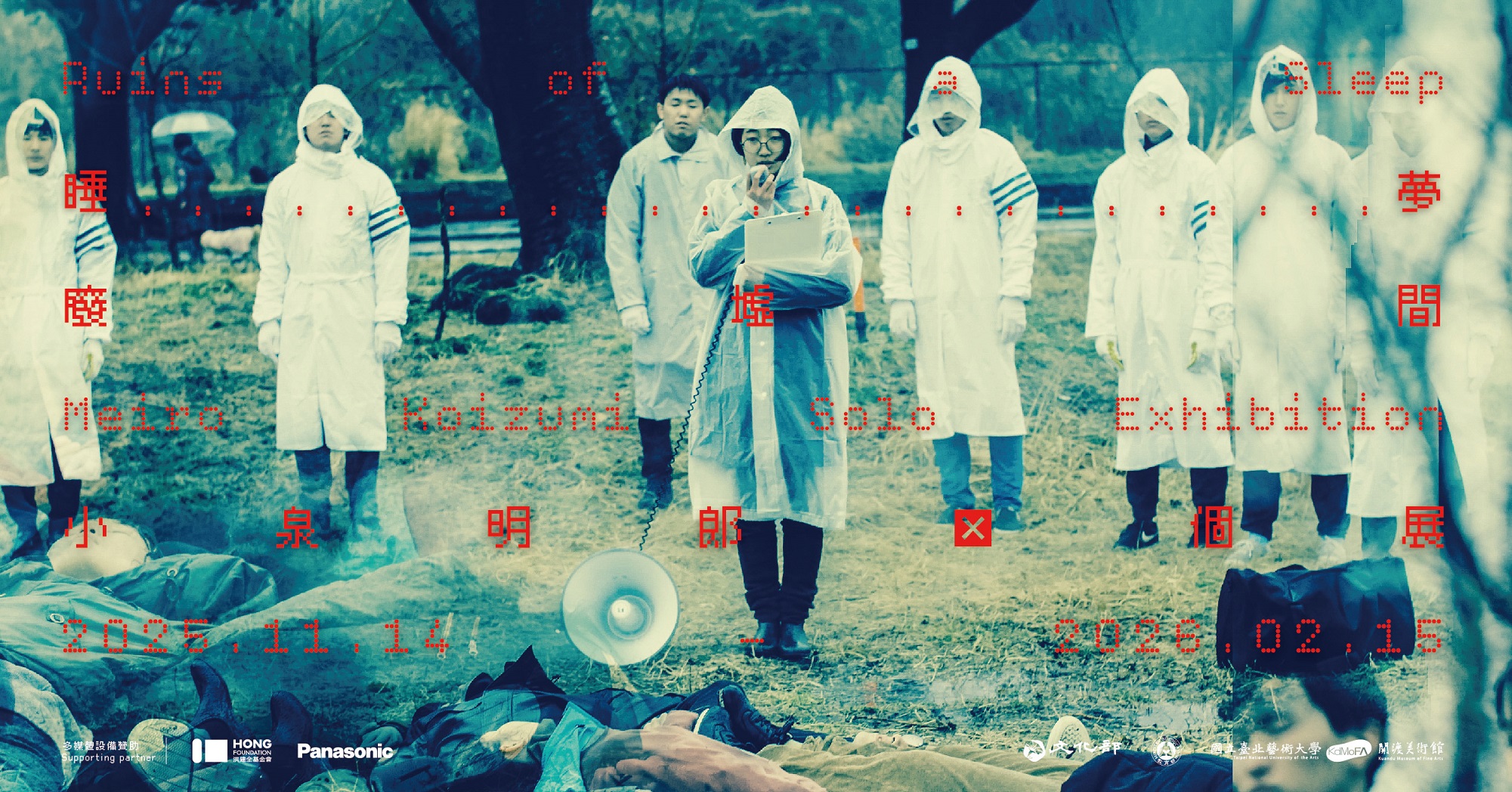
The five-channel installation We Mourn the Dead of the Future was directed by Koizumi and created collaboratively with twenty young Japanese participants during a two-day workshop. Beginning with the life story of a Japan Self-Defense Forces soldier, the work develops into a meditation on the tension between social-political imperatives and individual existence and freedom.
“Ruins of a Sleep” transforms long-suppressed, unspeakable memories into an elastic field of consciousness that stretches between dream and reality. Serving as the exhibition’s distant horizon, We Mourn the Dead of the Future exposes, through the interweaving of vulnerability, authority, and identity, a critique of collective violence and the machinery of the state.
Exhibition Introduction
Ruins of a Sleep
“Ruins of a Sleep” reveals how Meiro Koizumi explores the interplay between the real and the illusory within “consciousness,” thereby granting his works dimensions of political critique and collective memory. The Angels of Testimony is based on an interview with Hajime Kondo, a 99-year-old veteran of the Second Sino-Japanese War, in which eleven young Japanese participants recite Kondo’s original testimony verbatim. Presented through two videos of differing lengths that play in continuous, desynchronized loops, the work reawakens a forgotten history through a process of re-consciousness.
In his latest work Soluble Meat, Koizumi employs an artificial-intelligence program, using the prompt “This is a tragic film about people gradually losing their free will.” By repeatedly feeding this prompt into archival black-and-white photographs of hypnosis sessions, and looping the process every five seconds, the artist generates a film that unfolds like a disordered dream. The AI-generated narration that accompanies the film transforms it into a kind of algorithmic “stream of consciousness.”
The five-channel installation We Mourn the Dead of the Future was directed by Koizumi and created collaboratively with twenty young Japanese participants during a two-day workshop. Beginning with the life story of a Japan Self-Defense Forces soldier, the work develops into a meditation on the tension between social-political imperatives and individual existence and freedom.
“Ruins of a Sleep” transforms long-suppressed, unspeakable memories into an elastic field of consciousness that stretches between dream and reality. Serving as the exhibition’s distant horizon, We Mourn the Dead of the Future exposes, through the interweaving of vulnerability, authority, and identity, a critique of collective violence and the machinery of the state.
About the Artist
Meiro Koizumi
Meiro Koizumi is born in Japan in 1976. He lives and works in Yokohama. He is internationally recognized for his experimental video installations and immersive environments. His practice often explores the tension between private emotion and collective memory, and examines how systems of power—whether political, cultural, or technological—shape the individual. Working across video, drawing, sculpture, and more recently VR and AI, he consistently draws viewers into psychological spaces where fragility, authority, and identity are put to the test. His experimental VR Theater piece “Prometheus Bound” won the Grand Prize in the 24th Art Division of the Japan Media Arts Festival. In 2021, he won Artes Mundi Prize (Cardiff, UK).
His solo exhibitions include “Theaters of Life” at De Pont Museum (2025), “Good Machine Bad Machine" at Annet Gelink Gallery (2023), "Battlelands" at Minneapolis Institute of Fine Art (2019), "Battlelands" at Perez Art Museum Miami (2018), “Portrait of a Failed Silence”, MUAC, Mexico City (2015), and “Project Series 99: Meiro Koizumi” at Museum of Modern Art, New York (2013). Recent group shows include 14th Gwangju Biennale (2023), "Listen to the Sound of the Earth Turning", Mori Art Museum (2022), Aichi Triennale (2019), “Leaving Echo Chember”, Sharjah Biennale 14 (2018), “Proregress”, 12th Shanghai Biennale (2018), The 9th Asia Pacific Triennale, Brisbane (2018).
About the Artist
Meiro Koizumi
Meiro Koizumi is born in Japan in 1976. He lives and works in Yokohama. He is internationally recognized for his experimental video installations and immersive environments. His practice often explores the tension between private emotion and collective memory, and examines how systems of power—whether political, cultural, or technological—shape the individual. Working across video, drawing, sculpture, and more recently VR and AI, he consistently draws viewers into psychological spaces where fragility, authority, and identity are put to the test. His experimental VR Theater piece “Prometheus Bound” won the Grand Prize in the 24th Art Division of the Japan Media Arts Festival. In 2021, he won Artes Mundi Prize (Cardiff, UK).
His solo exhibitions include “Theaters of Life” at De Pont Museum (2025), “Good Machine Bad Machine" at Annet Gelink Gallery (2023), "Battlelands" at Minneapolis Institute of Fine Art (2019), "Battlelands" at Perez Art Museum Miami (2018), “Portrait of a Failed Silence”, MUAC, Mexico City (2015), and “Project Series 99: Meiro Koizumi” at Museum of Modern Art, New York (2013). Recent group shows include 14th Gwangju Biennale (2023), "Listen to the Sound of the Earth Turning", Mori Art Museum (2022), Aichi Triennale (2019), “Leaving Echo Chember”, Sharjah Biennale 14 (2018), “Proregress”, 12th Shanghai Biennale (2018), The 9th Asia Pacific Triennale, Brisbane (2018).

About the Works
《Soluble Meat》

Single channel video installation 7hrs
2025
Koizumi created his latest work, Soluble Meat, using an Al program called Luma Dream Machine. He fed the Al old black and white photos of hypnosis sessions and gave it the following prompt: 'This is a tragic film about people losing their free will'. The artist then repeatedly fed the composite image created by algorithms back into the program, with the same prompt. By repeating this process every five seconds, he created a film in which incomprehensible events are slowly taking place. The scenes are familiar; yet like a confusing dream, they have no logic behind them.
These strange video sequences were then entered into an Al program called Google Gemini to interpret them in order to create the voice-over. Although Koizumi sees the film as an Al stream of consciousness, he emphasises that there is always a human behind the input and decision-making.
In this way, the film is reminiscent of automatic writing, a method the surrealists used to tap into their subconscious minds 100 years ago.
About the Works
《Soluble Meat》

Single channel video installation 7hrs
2025
Koizumi created his latest work, Soluble Meat, using an Al program called Luma Dream Machine. He fed the Al old black and white photos of hypnosis sessions and gave it the following prompt: 'This is a tragic film about people losing their free will'. The artist then repeatedly fed the composite image created by algorithms back into the program, with the same prompt. By repeating this process every five seconds, he created a film in which incomprehensible events are slowly taking place. The scenes are familiar; yet like a confusing dream, they have no logic behind them.
These strange video sequences were then entered into an Al program called Google Gemini to interpret them in order to create the voice-over. Although Koizumi sees the film as an Al stream of consciousness, he emphasises that there is always a human behind the input and decision-making.
In this way, the film is reminiscent of automatic writing, a method the surrealists used to tap into their subconscious minds 100 years ago.
《The Angels of Testimony》

3 channel video installation with archival documents
Interview video (30min-looped) Performance video (47min-looped)
2019
This work is based on an interview with Mr. Hajime Kondo, a 99-year-old war veteran from the Second Sino-Japanese War (1937–1945).
Mr. Kondo is one of the few veterans who have bravely given testimonies about the war crimes he committed during the war. These testimonies include the killing of civilians and the gang-raping of women. In the interview, Koizumi asked him whether he remembered his own testimonies, and they found that he is now too old to recall most of the events described in them.
After the interview, the artist asked eleven young Japanese people (aged 16 to 26) to memorize Mr. Kondo’s original testimony word by word, and together they created performances based on these words.
In the installation, the interview footage (30 minutes long - looped) is juxtaposed with the young people’s footages (47 minutes long - looped). Since the duration of the videos are different, their combinations are never the same. It continuously searches new ways of representing the history, which is almost forgotten both from personal and collective consciousness.
《The Angels of Testimony》

3 channel video installation with archival documents
Interview video (30min-looped) Performance video (47min-looped)
2019
This work is based on an interview with Mr. Hajime Kondo, a 99-year-old war veteran from the Second Sino-Japanese War (1937–1945).
Mr. Kondo is one of the few veterans who have bravely given testimonies about the war crimes he committed during the war. These testimonies include the killing of civilians and the gang-raping of women. In the interview, Koizumi asked him whether he remembered his own testimonies, and they found that he is now too old to recall most of the events described in them.
After the interview, the artist asked eleven young Japanese people (aged 16 to 26) to memorize Mr. Kondo’s original testimony word by word, and together they created performances based on these words.
In the installation, the interview footage (30 minutes long - looped) is juxtaposed with the young people’s footages (47 minutes long - looped). Since the duration of the videos are different, their combinations are never the same. It continuously searches new ways of representing the history, which is almost forgotten both from personal and collective consciousness.
《We Mourn the Dead of the Future》

5 channel video installation 49minutes 48sec
2019
Meiro Koizumi made a performance with 20 Japanese young people through a two-day workshop. On the first day, they invited a soldier of the Japanese Self-Defense Force to talk about his job, his experience, his motivations, and his life. They also had a long discussion about what it means to join the army, who the people joining the army are, why we need the army, and so on. At the end of the first day, everyone had to make a statement about self-sacrifice.
They had to write a statement either:

“I would sacrifice my life for OOOO, because ….”
OR “I would never sacrifice my life, because ….”

On the second day, they created a ritual together where they had to manifest the statement in public, in a ritual that suggested the scene of a mass execution. And in the heavy rain, under the gaze of the audience, the 20 young people made this intense performance/ritual.
《We Mourn the Dead of the Future》

5 channel video installation 49minutes 48sec
2019
Meiro Koizumi made a performance with 20 Japanese young people through a two-day workshop. On the first day, they invited a soldier of the Japanese Self-Defense Force to talk about his job, his experience, his motivations, and his life. They also had a long discussion about what it means to join the army, who the people joining the army are, why we need the army, and so on. At the end of the first day, everyone had to make a statement about self-sacrifice.
They had to write a statement either:

“I would sacrifice my life for OOOO, because ….”
OR “I would never sacrifice my life, because ….”

On the second day, they created a ritual together where they had to manifest the statement in public, in a ritual that suggested the scene of a mass execution. And in the heavy rain, under the gaze of the audience, the 20 young people made this intense performance/ritual.