jump to the central content area
:::

Kuandu Museum of Fine Arts

:::
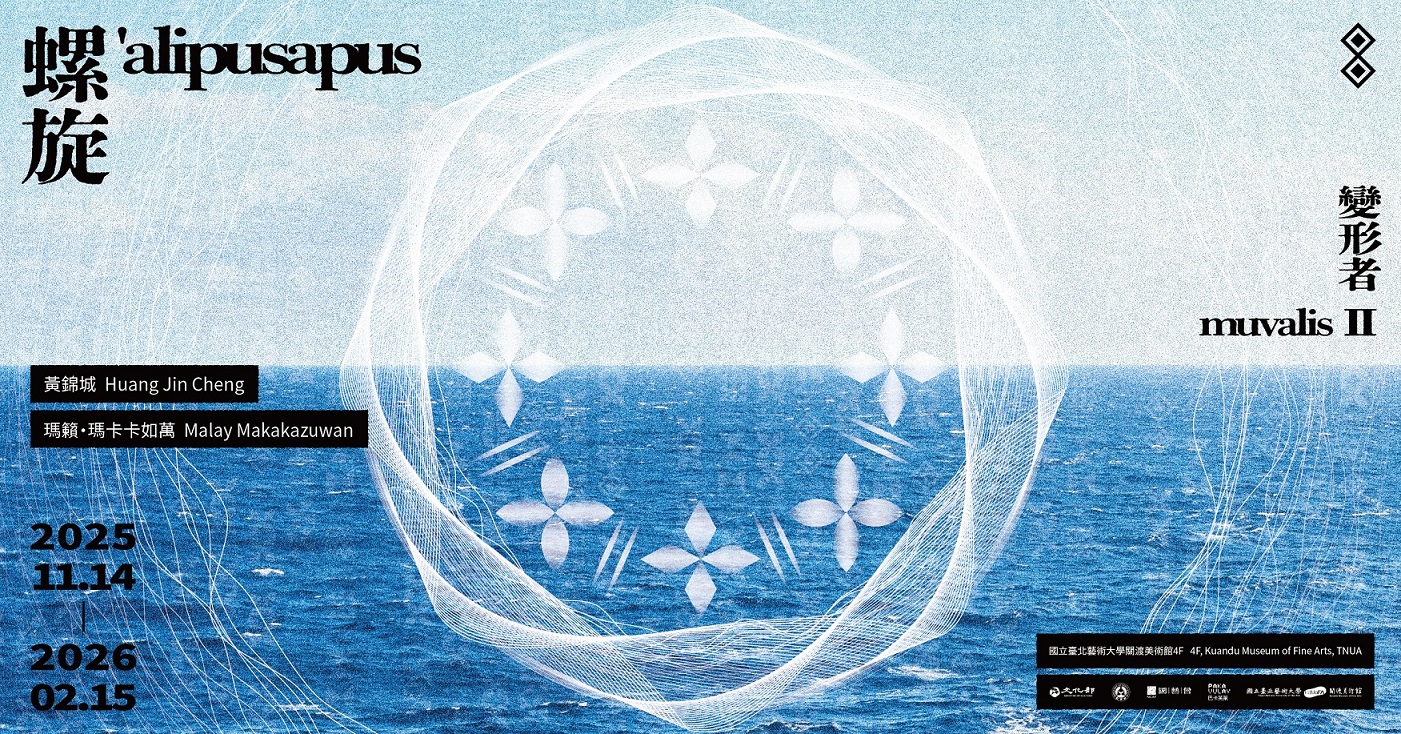
'alipusapus - muvalis II
2025.11.14~2026.02.15
10:00 - 17:00
4F, KdMoFA
Exhibition Introduction
“Death is not an end, but a process of transformation into the ancestral realm.
The ancestors have never left—they remain a sacred presence among the living.”

— Malay Makakazuwan
Exhibition Introduction
“Death is not an end, but a process of transformation into the ancestral realm.
The ancestors have never left—they remain a sacred presence among the living.”

— Malay Makakazuwan
Farewell of the Soul|Transformation and Sacred Voyage
During her 2023 residency at the Govett-Brewster Art Gallery in New Zealand, Malay was originally scheduled to exhibit alongside Amis artist Lafin Sawmah. However,who unexpectedly passed away in Taiwan before the show. The following year, during the exhibition installation, the artists were invited to join a Māori New Year memorial ceremony. Lafin’s photograph was placed at the center of the marae(Māori meeting place)alongside the Māori deceased. In that ceremony, songs and stories wove together a route for the soul’s journey, allowing Malay to deeply feel the Māori reverence for the spiritual cycle of life and death.
That same year, her father and maternal uncle both passed away. At the year’s end, her family participated in the Meraparapas ritual during the Mangayaw (the Puyuma Great Hunting Festival), led by a rahan (Puyuma priest), whose chants and ritual acts guided the release of grief and the settling of spirits, restoring harmony between family and community. Mangayaw is a complex ritual integrating adulthood training, headhunting, ancestor worship, and mourning purification—a passage symbolizing physical growth, spiritual discipline, kinship connection, and renewal of life.
These overlapping encounters of loss and ritual prompted Malay to reexamine death as an integral part of life’s cyclical continuum. During her 2011 field study in Pinaski, she once asked a priest, “Where do souls go after death?” He replied, “The spirit rides on a shell ginger leaf, paddling toward Sige Mountain—the dwelling of the ancestors.” This echoes the Māori belief that the soul travels along Te Rerenga Wairua to return to Hawaiki—a sacred oceanic voyage of the spirit returning to its ancestral source.
Farewell of the Soul|Transformation and Sacred Voyage
During her 2023 residency at the Govett-Brewster Art Gallery in New Zealand, Malay was originally scheduled to exhibit alongside Amis artist Lafin Sawmah. However,who unexpectedly passed away in Taiwan before the show. The following year, during the exhibition installation, the artists were invited to join a Māori New Year memorial ceremony. Lafin’s photograph was placed at the center of the marae(Māori meeting place)alongside the Māori deceased. In that ceremony, songs and stories wove together a route for the soul’s journey, allowing Malay to deeply feel the Māori reverence for the spiritual cycle of life and death.
That same year, her father and maternal uncle both passed away. At the year’s end, her family participated in the Meraparapas ritual during the Mangayaw (the Puyuma Great Hunting Festival), led by a rahan (Puyuma priest), whose chants and ritual acts guided the release of grief and the settling of spirits, restoring harmony between family and community. Mangayaw is a complex ritual integrating adulthood training, headhunting, ancestor worship, and mourning purification—a passage symbolizing physical growth, spiritual discipline, kinship connection, and renewal of life.
These overlapping encounters of loss and ritual prompted Malay to reexamine death as an integral part of life’s cyclical continuum. During her 2011 field study in Pinaski, she once asked a priest, “Where do souls go after death?” He replied, “The spirit rides on a shell ginger leaf, paddling toward Sige Mountain—the dwelling of the ancestors.” This echoes the Māori belief that the soul travels along Te Rerenga Wairua to return to Hawaiki—a sacred oceanic voyage of the spirit returning to its ancestral source.
'alipusapus|Rituals of Shapeshifting and Return
'alipusapus is a creative action centered on life, spirit, ritual, and transformation. Drawing from the three core phases of the Puyuma Mangayaw—Monkey Ceremony (initiation), Headhunting (collective action), and Mourning Purification (rebirth and cleansing)—the work interlaces personal experiences of loss with cultural intersections, constructing an artistic passage that traverses self and community, the contemporary and the ancestral, the sensory and the spiritual.
The spiral serves as the central visual and conceptual motif of the project, symbolizing the unfolding and continual metamorphosis of life. The circle, beyond its formal appearance, embodies the inner order of the cosmos: circular dance represents the cycle of existence and communal harmony, while floral wreaths mark blessings and transitional moments. These cultural elements are transformed into walkable paths, woven installations, sonic invocations, and animated imagery—becoming vessels of ritual and containers of spirit.
In this process, the artists assume the role of a “contemporary shapeshifter,” navigating between identity, culture, and spirit. Through artistic practice, they invoke ancestral presences, responds to embodied memory, and reestablishes a resonance with nature. 'alipusapus is not merely a creative endeavor but a ritual journey—an attempt to find, within the fractures of cultural transformation, a sacred path home for the soul.
The work encompasses painting, weaving, mixed media, sound collection, and video, layering corporeal, sonic, and material dimensions. At the threshold between personal experience and collective memory, it extends the unfinished myth and envisions new possibilities for cultural continuity.
'alipusapus|Rituals of Shapeshifting and Return
'alipusapus is a creative action centered on life, spirit, ritual, and transformation. Drawing from the three core phases of the Puyuma Mangayaw—Monkey Ceremony (initiation), Headhunting (collective action), and Mourning Purification (rebirth and cleansing)—the work interlaces personal experiences of loss with cultural intersections, constructing an artistic passage that traverses self and community, the contemporary and the ancestral, the sensory and the spiritual.
The spiral serves as the central visual and conceptual motif of the project, symbolizing the unfolding and continual metamorphosis of life. The circle, beyond its formal appearance, embodies the inner order of the cosmos: circular dance represents the cycle of existence and communal harmony, while floral wreaths mark blessings and transitional moments. These cultural elements are transformed into walkable paths, woven installations, sonic invocations, and animated imagery—becoming vessels of ritual and containers of spirit.
In this process, the artists assume the role of a “contemporary shapeshifter,” navigating between identity, culture, and spirit. Through artistic practice, they invoke ancestral presences, responds to embodied memory, and reestablishes a resonance with nature. 'alipusapus is not merely a creative endeavor but a ritual journey—an attempt to find, within the fractures of cultural transformation, a sacred path home for the soul.
The work encompasses painting, weaving, mixed media, sound collection, and video, layering corporeal, sonic, and material dimensions. At the threshold between personal experience and collective memory, it extends the unfinished myth and envisions new possibilities for cultural continuity.

About the Artist
Malay Makakazuwan(b. 1980)
A Puyuma artist from the Pinaski community in Taitung, Malay Makakazuwan grew up with her grandparents while her parents were among the first generation of Indigenous urban migrants. Trained in fine arts in Kaohsiung and Taipei, she worked in design before turning to explore Indigenous identity through art. In 2002, she studied at National Dong Hwa University, deepening her cultural awareness. From 2008 to 2012, she joined the Indigenous Artist Residency Program, returning to her village to relearn language, myths, and traditions. Her practice employs natural materials and traditional crafts to reconnect personal and collective memory.
About the Artist
Malay Makakazuwan(b. 1980)
A Puyuma artist from the Pinaski community in Taitung, Malay Makakazuwan grew up with her grandparents while her parents were among the first generation of Indigenous urban migrants. Trained in fine arts in Kaohsiung and Taipei, she worked in design before turning to explore Indigenous identity through art. In 2002, she studied at National Dong Hwa University, deepening her cultural awareness. From 2008 to 2012, she joined the Indigenous Artist Residency Program, returning to her village to relearn language, myths, and traditions. Her practice employs natural materials and traditional crafts to reconnect personal and collective memory.
Huang Jin-Cheng (b. 1969)
A member of the Kavalan people from the Tanavi community (present-day Dongshan, Yilan), Huang Jin-Cheng now lives and works in Cikasuwan, Hualien. During military service, he published Listening in the Dark, a poetry collection that shaped his later creative style. Afterward, he worked as a teacher, editor, and designer, and joined local art initiatives repurposing historical sites. A brief greeting from a Truku elder inspired his reflection on Indigenous identity. Using natural materials and found objects, his installations interweave history and everyday life, poetry and politics, to confront the marginal conditions of Indigenous peoples under colonial legacies.
Huang Jin-Cheng (b. 1969)
A member of the Kavalan people from the Tanavi community (present-day Dongshan, Yilan), Huang Jin-Cheng now lives and works in Cikasuwan, Hualien. During military service, he published Listening in the Dark, a poetry collection that shaped his later creative style. Afterward, he worked as a teacher, editor, and designer, and joined local art initiatives repurposing historical sites. A brief greeting from a Truku elder inspired his reflection on Indigenous identity. Using natural materials and found objects, his installations interweave history and everyday life, poetry and politics, to confront the marginal conditions of Indigenous peoples under colonial legacies.
About the works
Red Body in the Room

Plastic bags, nylon ropes, black gauze nets, canvas, steel cables, iron nets, 2025

Dimensions: 500*300*400 cm


Every disillusionment is like a fierce fire in the night, burning away tenderness while illuminating the defenses of the soul, transforming into a gift of growth.

This work merges and juxtaposes memories of childhood in the Puyuma tribe's Pinaski village, where pigs were slaughtered and shared, with the symbolism of the monkey sacrifice ritual of piercing monkeys, presenting the shocking experiences at the dawn of life. The opened body, the steam, and the impact of blood color reflect the moments when a youth confronts the boundaries of flight in the ritual. The familial bonds of dividing meat hint at the budding of social responsibility, while the initiation trial represented by piercing monkeys transforms fear into endurance. The work points to the core of growth: seeing the weight of life in real collisions, allowing disillusionment to become the gateway to awakened consciousness.
About the works
Red Body in the Room

Plastic bags, nylon ropes, black gauze nets, canvas, steel cables, iron nets, 2025

Dimensions: 500*300*400 cm


Every disillusionment is like a fierce fire in the night, burning away tenderness while illuminating the defenses of the soul, transforming into a gift of growth.

This work merges and juxtaposes memories of childhood in the Puyuma tribe's Pinaski village, where pigs were slaughtered and shared, with the symbolism of the monkey sacrifice ritual of piercing monkeys, presenting the shocking experiences at the dawn of life. The opened body, the steam, and the impact of blood color reflect the moments when a youth confronts the boundaries of flight in the ritual. The familial bonds of dividing meat hint at the budding of social responsibility, while the initiation trial represented by piercing monkeys transforms fear into endurance. The work points to the core of growth: seeing the weight of life in real collisions, allowing disillusionment to become the gateway to awakened consciousness.
Wisdom of Peace

Iron, bamboo bows, hemp ropes, wool felt, animal bones, eggshells, animal traps, projection equipment, 2025

Dimensions: Variable depending on space (180*30*10cm*3, 164*200*46cm, 01’46’’)

In the memories of the Puyuma tribe, the Mangayaw (Grand Hunting Festival) was once a symbol of courage and protection—youths marching shoulder to shoulder, not just for prey, but for the dignity of the tribe and the continuation of the land. As times change, headhunting fades away, leaving only that forging and vigilance echoing in the rituals. The great chief of the Ulivelivek (Chulu tribe) , Tribal Leader Matreli (1887—October 20, 1966), though not indigenous by birth, used the wisdom and courage of the tribe to resolve two centuries of enmity, allowing Taitung to remain silently safe amid turmoil.

However, in today's world, flames of war ignite once more. From Eastern Europe to the Middle East, tanks roll over squares, missiles streak across the sky. Lands are torn apart, lives devoured, hatred cycles like echoes in a hunting ground. Tribes lose their land, cultures become exiles; hunters lose their forests, chasing footprints only in memory.

Wisdom of Peace gazes not only at the lament of history, but also at humanity's eternal struggle between war and peace.
Wisdom of Peace

Iron, bamboo bows, hemp ropes, wool felt, animal bones, eggshells, animal traps, projection equipment, 2025

Dimensions: Variable depending on space (180*30*10cm*3, 164*200*46cm, 01’46’’)

In the memories of the Puyuma tribe, the Mangayaw (Grand Hunting Festival) was once a symbol of courage and protection—youths marching shoulder to shoulder, not just for prey, but for the dignity of the tribe and the continuation of the land. As times change, headhunting fades away, leaving only that forging and vigilance echoing in the rituals. The great chief of the Ulivelivek (Chulu tribe) , Tribal Leader Matreli (1887—October 20, 1966), though not indigenous by birth, used the wisdom and courage of the tribe to resolve two centuries of enmity, allowing Taitung to remain silently safe amid turmoil.

However, in today's world, flames of war ignite once more. From Eastern Europe to the Middle East, tanks roll over squares, missiles streak across the sky. Lands are torn apart, lives devoured, hatred cycles like echoes in a hunting ground. Tribes lose their land, cultures become exiles; hunters lose their forests, chasing footprints only in memory.

Wisdom of Peace gazes not only at the lament of history, but also at humanity's eternal struggle between war and peace.
'alipusapus za kavaawan (Returning to the Spiral Boat of Souls)

Shell Ginger (Yuetao), Shell Ginger (Yuetao) seeds, projection equipment, 2025

Dimensions: Variable depending on space (250*118*24 cm, 160*60*15 cm, 68*32*15 cm, 32*16*10 cm, 04:46)

In the traditions of the Puyuma tribe, the mourning removal ritual meraparapas is a ceremony of farewell and rebirth. When the songs of the grand hunting festival mangayaw fade, the tribe holds a purification rite for families who have lost loved ones in the past year—driving away misfortune through song and dance, allowing grieving souls to return to the light and dance once more with the tribe. Life and death intertwine here, like a slowly rotating spiral of life, constantly cycling between birth and extinction.

During fieldwork in Pinaski village in 2011, I asked the rahan (priest): "Where do people go after death?" He said: "The soul rides on peach leaves, transforming into a boat of souls, paddling toward Sige Mountain—that is the abode of the ancestors." In that moment, I recalled the distant Maori legend—souls returning to Hawaiki (ancestral homeland) along the cliffs of Te Rerenga Wairua (Cape Reinga, the leaping place of souls). The ancestors of the Austronesian peoples may be riding the same spirit boat, traversing time and sea mist, spiraling in the memories of waves. This is a journey of return—the boat of souls sails along the trajectory of the life spiral, following the flow of memory, navigating between mountains and seas, back to that immortal, shining homeland.
'alipusapus za kavaawan (Returning to the Spiral Boat of Souls)

Shell Ginger (Yuetao), Shell Ginger (Yuetao) seeds, projection equipment, 2025

Dimensions: Variable depending on space (250*118*24 cm, 160*60*15 cm, 68*32*15 cm, 32*16*10 cm, 04:46)

In the traditions of the Puyuma tribe, the mourning removal ritual meraparapas is a ceremony of farewell and rebirth. When the songs of the grand hunting festival mangayaw fade, the tribe holds a purification rite for families who have lost loved ones in the past year—driving away misfortune through song and dance, allowing grieving souls to return to the light and dance once more with the tribe. Life and death intertwine here, like a slowly rotating spiral of life, constantly cycling between birth and extinction.

During fieldwork in Pinaski village in 2011, I asked the rahan (priest): "Where do people go after death?" He said: "The soul rides on peach leaves, transforming into a boat of souls, paddling toward Sige Mountain—that is the abode of the ancestors." In that moment, I recalled the distant Maori legend—souls returning to Hawaiki (ancestral homeland) along the cliffs of Te Rerenga Wairua (Cape Reinga, the leaping place of souls). The ancestors of the Austronesian peoples may be riding the same spirit boat, traversing time and sea mist, spiraling in the memories of waves. This is a journey of return—the boat of souls sails along the trajectory of the life spiral, following the flow of memory, navigating between mountains and seas, back to that immortal, shining homeland.