jump to the central content area
:::

Kuandu Museum of Fine Arts

:::
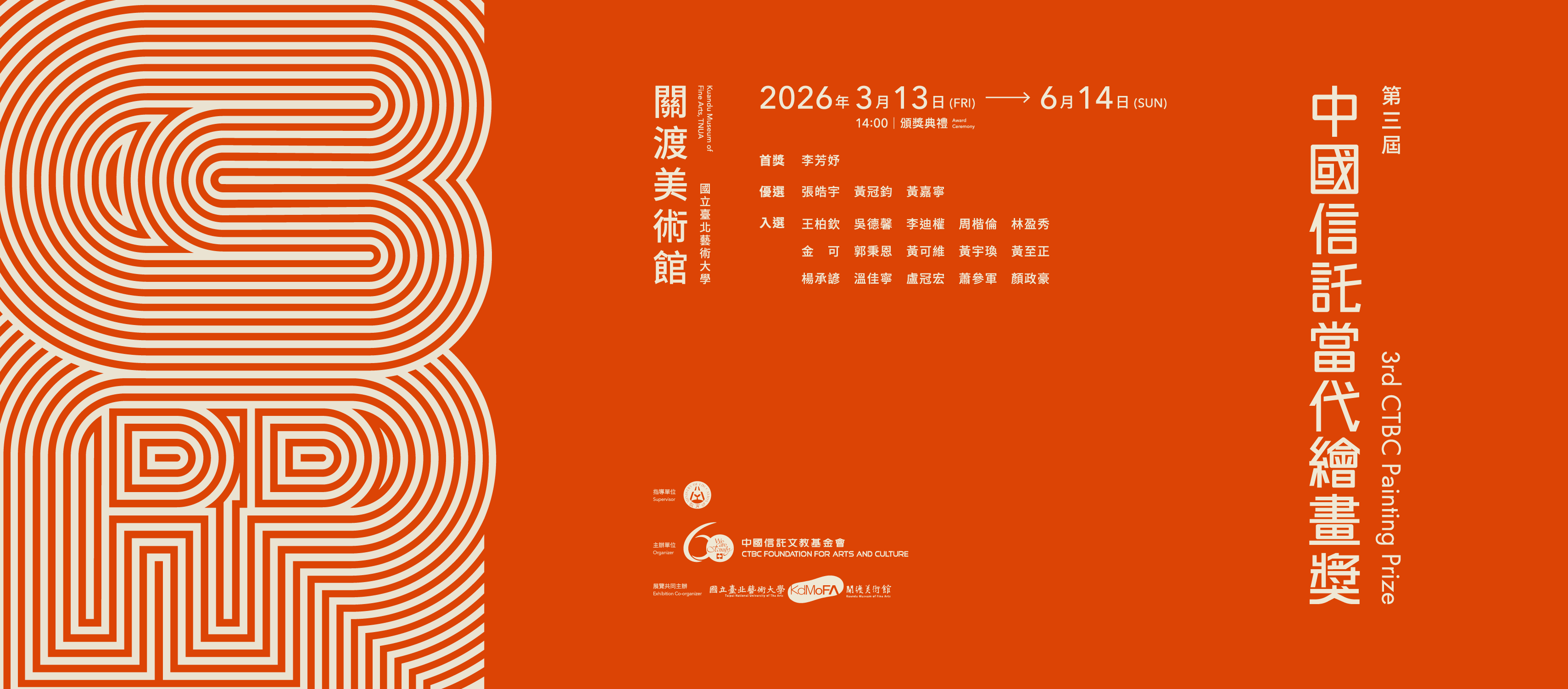
The 3rd CTBC Painting Prize
2026.03.13~2026.06.14
10:00 - 17:00
2F - 4F, KdMoFA
Prize winners and exhibitioners :
First Prize: Lee Fang-Yu

Merit Prize: Chang Hao-Yu, Huang Kuan-Chun, Huang Chia-Ning
Honorable Mention:
Wang Po-Chin, Grace Wu, Lee Tek-Khean, Chou Kai-Lun, Lin Ying-Hsiu, Chin Ko, Kuo Ping-En, Huang Ko-Wei, Huang Yu-Huan, Huang Chih-Cheng, Yang Cheng-Yen, Wen Chia-Ning, Lu Guan-Hong, Hsiao Tsan-Chun, Yan Jheng-Hao


(names in Mandarin alphabetical order)
Prize winners and exhibitioners :
First Prize: Lee Fang-Yu

Merit Prize: Chang Hao-Yu, Huang Kuan-Chun, Huang Chia-Ning
Honorable Mention:
Wang Po-Chin, Grace Wu, Lee Tek-Khean, Chou Kai-Lun, Lin Ying-Hsiu, Chin Ko, Kuo Ping-En, Huang Ko-Wei, Huang Yu-Huan, Huang Chih-Cheng, Yang Cheng-Yen, Wen Chia-Ning, Lu Guan-Hong, Hsiao Tsan-Chun, Yan Jheng-Hao


(names in Mandarin alphabetical order)
Exhibition Introduction
The CTBC Painting Prize is a biennial initiative dedicated to nurturing innovative young and mid-career artists and fostering contemporary painting practice. Embracing an open-ended ethos, the award imposes no restrictions on theme, medium, or scale, encouraging artists to venture into experimental territories and challenge the possibilities of the painted form. From a competitive pool of 632 submissions, the jury has selected 19 exceptional works to be exhibited at the Kuandu Museum of Fine Arts. Among these, one First Prize and three Merit Prizes will enter the permanent collection of the CTBC Foundation for Arts and Culture, utilizing corporate resources to sustain the long-term development of contemporary painting.

The selected works of this edition illustrate the multifaceted trajectories of contemporary painting in terms of form, medium, and ways of seeing. Adopting a more casual and everyday posture, these practices engage with daily experience and the essence of perception, dismantling traditional definitions to unveil the liberating potential of painting. Broadly speaking, three primary creative inclinations emerge:

Firstly, through experiments with materials and techniques, artists explore the spatial, luminous, and material extensions of painting, thereby redefining the relationship between the painted form and the viewer.

Secondly, the works engage with contemporary visual contexts and the intersections of media—encompassing digital platforms, social media imagery, and the resignification of historical texts—to manifest the fluidity in image generation, reconfiguration, and interpretation.

Finally, artists provoke a critical reflection of the act of viewing and perceptual experience. Through the ambiguity of imagery, shifting forms, and the intervention of the gaze, viewers are encouraged to recalibrate their perception of painting, time, and the everyday.

Through these intersecting threads, the exhibition not only showcases diverse creative explorations but also highlights the sensitivity of contemporary art towards society, history, and daily life. Together, they form an open and fluid field of observation, demonstrating the contemporary expressive vocabulary and enduring value of painting.
Exhibition Introduction
The CTBC Painting Prize is a biennial initiative dedicated to nurturing innovative young and mid-career artists and fostering contemporary painting practice. Embracing an open-ended ethos, the award imposes no restrictions on theme, medium, or scale, encouraging artists to venture into experimental territories and challenge the possibilities of the painted form. From a competitive pool of 632 submissions, the jury has selected 19 exceptional works to be exhibited at the Kuandu Museum of Fine Arts. Among these, one First Prize and three Merit Prizes will enter the permanent collection of the CTBC Foundation for Arts and Culture, utilizing corporate resources to sustain the long-term development of contemporary painting.

The selected works of this edition illustrate the multifaceted trajectories of contemporary painting in terms of form, medium, and ways of seeing. Adopting a more casual and everyday posture, these practices engage with daily experience and the essence of perception, dismantling traditional definitions to unveil the liberating potential of painting. Broadly speaking, three primary creative inclinations emerge:

Firstly, through experiments with materials and techniques, artists explore the spatial, luminous, and material extensions of painting, thereby redefining the relationship between the painted form and the viewer.

Secondly, the works engage with contemporary visual contexts and the intersections of media—encompassing digital platforms, social media imagery, and the resignification of historical texts—to manifest the fluidity in image generation, reconfiguration, and interpretation.

Finally, artists provoke a critical reflection of the act of viewing and perceptual experience. Through the ambiguity of imagery, shifting forms, and the intervention of the gaze, viewers are encouraged to recalibrate their perception of painting, time, and the everyday.

Through these intersecting threads, the exhibition not only showcases diverse creative explorations but also highlights the sensitivity of contemporary art towards society, history, and daily life. Together, they form an open and fluid field of observation, demonstrating the contemporary expressive vocabulary and enduring value of painting.
The First Prize
Lee Fang-Yu

〈White Ceramic Tiles, Flower, Gap〉
Acrylic, charcoal, laser sticker, white ceramic tiles
184×1475.5×6 cm, 2025
Lee Fang-Yu transposes familiar everyday objects and imagery into a light visual language. In〈White Ceramic Tiles, Flower, Gap〉, she utilizes 648 white tiles—each measuring 20 centimeter square, an ubiquitous material found on building facades and in domestic spaces across Taiwan. She draws grid lines using a dripping technique, then depicts yellow tulips with eyes across units of nine tiles. These are subsequently dismantled and reassembled, either randomly or consciously, causing the imagery to shift continuously. Through this process, the artist dissolves the visual inertia associated with tile grids. By treating the act of reassembly as a method of painting, she ensures the composition remains dynamic, allowing the work to continuously extend and expand within the space.

Lee’s practice focuses on the variability of everyday observation, blurring the boundaries of established cognitive frameworks through the dismantling, reassembling, and material experimentation of symbols and imagery. Adopting a humorous and liberated stance, her work creates a gateway through the solemnity of the mundane, inviting viewers to re-experience common objects and transcend familiar visual patterns, thereby uncovering the overlooked playfulness and latent possibilities within the everyday.
The First Prize
Lee Fang-Yu

〈White Ceramic Tiles, Flower, Gap〉
Acrylic, charcoal, laser sticker, white ceramic tiles
184×1475.5×6 cm, 2025
Lee Fang-Yu transposes familiar everyday objects and imagery into a light visual language. In〈White Ceramic Tiles, Flower, Gap〉, she utilizes 648 white tiles—each measuring 20 centimeter square, an ubiquitous material found on building facades and in domestic spaces across Taiwan. She draws grid lines using a dripping technique, then depicts yellow tulips with eyes across units of nine tiles. These are subsequently dismantled and reassembled, either randomly or consciously, causing the imagery to shift continuously. Through this process, the artist dissolves the visual inertia associated with tile grids. By treating the act of reassembly as a method of painting, she ensures the composition remains dynamic, allowing the work to continuously extend and expand within the space.

Lee’s practice focuses on the variability of everyday observation, blurring the boundaries of established cognitive frameworks through the dismantling, reassembling, and material experimentation of symbols and imagery. Adopting a humorous and liberated stance, her work creates a gateway through the solemnity of the mundane, inviting viewers to re-experience common objects and transcend familiar visual patterns, thereby uncovering the overlooked playfulness and latent possibilities within the everyday.
The Merit Prize
Chang Hao-Yu

〈Beginning with Water… Then a Simulated Narrative〉
Oil paint, charcoal on canvas
155×360×0.1cm, 2025


Chang Hao-Yu’s practice centers on the process of image generation, taking ‘water’ as a point of departure to construct an unfinished pictorial site. A group of figures frolic and dive by a lakeside, their varied movements dissolving into the scenery. The figures, stripped of identifiable features, remain as anonymous bodies awaiting a name, arrayed towards the viewer. The logic of layered viewing between the foreground and background guides the eye through the imagery; embedded drafts and charcoal markings within the frame transform the painterly process into the composition.

The pool functions as a stage, where figures exist in a state of rehearsal before the narrative unfolds—a state where the image remains undefined. The blurred postures and contours in the background hint at unfulfilled events or a silent past. Through the incompleteness and deferral of painting, Chang attempts to loosen the precision and closure of contemporary imagery, maintaining the fluidity of image generation to restore the painting as a site of emergence, where observation becomes an active participant in the shifting states of the image.
The Merit Prize
Chang Hao-Yu

〈Beginning with Water… Then a Simulated Narrative〉
Oil paint, charcoal on canvas
155×360×0.1cm, 2025


Chang Hao-Yu’s practice centers on the process of image generation, taking ‘water’ as a point of departure to construct an unfinished pictorial site. A group of figures frolic and dive by a lakeside, their varied movements dissolving into the scenery. The figures, stripped of identifiable features, remain as anonymous bodies awaiting a name, arrayed towards the viewer. The logic of layered viewing between the foreground and background guides the eye through the imagery; embedded drafts and charcoal markings within the frame transform the painterly process into the composition.

The pool functions as a stage, where figures exist in a state of rehearsal before the narrative unfolds—a state where the image remains undefined. The blurred postures and contours in the background hint at unfulfilled events or a silent past. Through the incompleteness and deferral of painting, Chang attempts to loosen the precision and closure of contemporary imagery, maintaining the fluidity of image generation to restore the painting as a site of emergence, where observation becomes an active participant in the shifting states of the image.
Huang Kuan-Chun

〈Space of Presence and Absence〉
Acrylic Ink, acrylic mediums
108×264×6cm, 2025
In the series Space of Presence and Absence, Huang Kuan-Chun investigates how light and shadow permeate, configure, and transform spatial environments. The artist is captivated by the incidental shadows encountered in daily life as they fall upon architectural walls; these fleeting, blurred, yet tension-filled forms inspire him to imagine whether painting could similarly manifest as a spatial entity.

Huang applies layers of acrylic pigment onto glass platforms, peeling the completed images away once dry. In this process, the pigment is no longer tethered to a canvas; instead, it becomes a suspended material that can be permeated by light. Through the dabbing of sponges, layers of black and yellow pigment form translucent strata. As light traverses these layers, it does not merely cast a shadow but leaves behind optical traces formed by the material's thickness—at once an afterimage of colour and an echo of matter. Through this methodology, the work ceases to be a mere representation of a scene; it interacts with the ambient light of the gallery to create a new, site-specific image. Painting is no longer just a subject for observation; it becomes a spatial happening, brought to light and spurred. The series dissolves the rigid constraints of painting as a static medium, evolving into a visual practice that drifts between reality and illusion, presence and absence.
Huang Kuan-Chun

〈Space of Presence and Absence〉
Acrylic Ink, acrylic mediums
108×264×6cm, 2025
In the series Space of Presence and Absence, Huang Kuan-Chun investigates how light and shadow permeate, configure, and transform spatial environments. The artist is captivated by the incidental shadows encountered in daily life as they fall upon architectural walls; these fleeting, blurred, yet tension-filled forms inspire him to imagine whether painting could similarly manifest as a spatial entity.

Huang applies layers of acrylic pigment onto glass platforms, peeling the completed images away once dry. In this process, the pigment is no longer tethered to a canvas; instead, it becomes a suspended material that can be permeated by light. Through the dabbing of sponges, layers of black and yellow pigment form translucent strata. As light traverses these layers, it does not merely cast a shadow but leaves behind optical traces formed by the material's thickness—at once an afterimage of colour and an echo of matter. Through this methodology, the work ceases to be a mere representation of a scene; it interacts with the ambient light of the gallery to create a new, site-specific image. Painting is no longer just a subject for observation; it becomes a spatial happening, brought to light and spurred. The series dissolves the rigid constraints of painting as a static medium, evolving into a visual practice that drifts between reality and illusion, presence and absence.
Huang Chia-Ning

〈Cactus Segment (Monkey Tail Cactus)〉
Oil on canvas
154×223×5cm, 2025
Huang Chia-Ning transposes photographic captures of cactus segments found in local markets into the medium of oil painting, inspired by a serendipitous encounter at a flower bazaar. The artist was initially drawn to the Monkey Tail Cactus, perceiving it as soft and downy; however, the unexpected sting upon contact provoked an association and reflection on the act of seeing and her artistic creation. This paradox—the coexistence of softness and sting—prompted her to interrogate whether vision functions as a double-edged sword: is seeing truly believing, and what latent meanings reside beneath the surface of things?

In her practice, Huang explores this subtle tension, and simultaneously comprehends, experiences, and maintains a distance from her subject with painting. Her work conveys her observation and feelings, unveiling overlooked details and inherent possibilities within the mundane. The depicted cacti serve not merely as concrete forms, but as vessels for an inquiry into perception and the experience of seeing.
Huang Chia-Ning

〈Cactus Segment (Monkey Tail Cactus)〉
Oil on canvas
154×223×5cm, 2025
Huang Chia-Ning transposes photographic captures of cactus segments found in local markets into the medium of oil painting, inspired by a serendipitous encounter at a flower bazaar. The artist was initially drawn to the Monkey Tail Cactus, perceiving it as soft and downy; however, the unexpected sting upon contact provoked an association and reflection on the act of seeing and her artistic creation. This paradox—the coexistence of softness and sting—prompted her to interrogate whether vision functions as a double-edged sword: is seeing truly believing, and what latent meanings reside beneath the surface of things?

In her practice, Huang explores this subtle tension, and simultaneously comprehends, experiences, and maintains a distance from her subject with painting. Her work conveys her observation and feelings, unveiling overlooked details and inherent possibilities within the mundane. The depicted cacti serve not merely as concrete forms, but as vessels for an inquiry into perception and the experience of seeing.
Honorable Mention
Wang Po-Chin

〈New System Sample 6: How to Cut Milk〉
Crayon, acrylic paint
110×286×3cm, 2025
Wang Po-Chin examines the visual experience of the new generation—a state where viewing no longer originates from reality, but is generated through screens and perpetually processed, reorganised, and reproduced across digital platforms. His works draw from meme imagery recommended by social media algorithms, encompassing unusual human behaviours, scenes, and objects. These are interwoven with authentic figures and events from the artist's own life, forming a fluid composition that blurs the boundaries between the virtual and the reality within a flattened visual structure.

Wang chooses crayons and acrylics—mediums that demand a labour-intensive, physical process—employing techniques of marking, layering, blurring, and formal distortion to respond to the ephemeral and fragmentary nature of internet imagery. The contours and structural arrangement serve not only to direct the eye but to mirror the stylistic consistency and surface-level nature of internet imagery. Wang’s practice investigates the evolution of contemporary modes of seeing, exploring how images become a phenomenon of consumption and collage under algorithmic dominance, while questioning the potential for reclaiming interpretation and generation through the act of painting.
Honorable Mention
Wang Po-Chin

〈New System Sample 6: How to Cut Milk〉
Crayon, acrylic paint
110×286×3cm, 2025
Wang Po-Chin examines the visual experience of the new generation—a state where viewing no longer originates from reality, but is generated through screens and perpetually processed, reorganised, and reproduced across digital platforms. His works draw from meme imagery recommended by social media algorithms, encompassing unusual human behaviours, scenes, and objects. These are interwoven with authentic figures and events from the artist's own life, forming a fluid composition that blurs the boundaries between the virtual and the reality within a flattened visual structure.

Wang chooses crayons and acrylics—mediums that demand a labour-intensive, physical process—employing techniques of marking, layering, blurring, and formal distortion to respond to the ephemeral and fragmentary nature of internet imagery. The contours and structural arrangement serve not only to direct the eye but to mirror the stylistic consistency and surface-level nature of internet imagery. Wang’s practice investigates the evolution of contemporary modes of seeing, exploring how images become a phenomenon of consumption and collage under algorithmic dominance, while questioning the potential for reclaiming interpretation and generation through the act of painting.
Grace Wu

〈M001〉
Acrylic on canvas
145.5×97×3.5cm ×2, 2025
Grace Wu conceives painting as a synthesis of visual and sensory perception, asserting that a work of art demands to be ‘lingered upon’. At first glance, M001 might be mistaken for a mechanical print or a digital output; however, the textures of the work dictate a ‘way of seeing’ that compels the viewer’s gaze to pause. Drawing inspiration from 19th-century East Asian chrysanthemum screens, M001 employs an elaborate, saturated compositional rhythm and a vibrant palette to evoke a visual experience akin to ‘profuse floral splendour’. By reconstructing the spatial logic and rhythmic arrangement of the original screens, Wu transposes the two-dimensional surface into a site of tension between cultural memory and sensory experience.

Regarding the pictorial texture, the interplay between the glossy, smooth surfaces and the densely impastoed pigments renders the image resistant to immediate recognition, denying the viewer a clear visual focal point. The work deliberately disrupts conventional viewing habits, prompting the audience to become conscious of their own gaze. In this process, ‘the gaze’ itself becomes a perceptual act requiring recalibration and awareness.
Grace Wu

〈M001〉
Acrylic on canvas
145.5×97×3.5cm ×2, 2025
Grace Wu conceives painting as a synthesis of visual and sensory perception, asserting that a work of art demands to be ‘lingered upon’. At first glance, M001 might be mistaken for a mechanical print or a digital output; however, the textures of the work dictate a ‘way of seeing’ that compels the viewer’s gaze to pause. Drawing inspiration from 19th-century East Asian chrysanthemum screens, M001 employs an elaborate, saturated compositional rhythm and a vibrant palette to evoke a visual experience akin to ‘profuse floral splendour’. By reconstructing the spatial logic and rhythmic arrangement of the original screens, Wu transposes the two-dimensional surface into a site of tension between cultural memory and sensory experience.

Regarding the pictorial texture, the interplay between the glossy, smooth surfaces and the densely impastoed pigments renders the image resistant to immediate recognition, denying the viewer a clear visual focal point. The work deliberately disrupts conventional viewing habits, prompting the audience to become conscious of their own gaze. In this process, ‘the gaze’ itself becomes a perceptual act requiring recalibration and awareness.
Lee Tek-Khean

〈Show Time Trilogy〉
Wood panel, oil paint, and copper leaf
183×549×0.7cm, 2025
Lee Tek-Khean has long dedicated his practice to the medium of woodblock printing, an art form that demands both intensive physical labour and profound concentration. He transposes the making process of woodcutting and its inherent historical weight into an act of artistic resistance that responds to present-day realities. Through the repetitive acts of carving and printing, the artist integrates historical events with everyday life into a unified pictorial system, crafting a narrative that is simultaneously satirical and imbued with theatrical tension.

Freedom, Democracy, Corruption
Justice, Sell-out, Equal-Rights
Anti-China, Autocracy, Unification
United-Front, Cyber-Militia, Wingers
Gong-swan, Stumping, Canvassing
Middle-Finger, Clamour, Online-Clout
Little-Grass, Green-Maggots, Infiltration
National-Security, Power-Grab, Warfare
Peace, Brawling, Malpractice-Hunt
Paralysis, Recall, Break-away
Mobilisation, Blue-Bird, Liquidation
Backfiring, Outcry, Populism
Showdown, Collapse, Finale
Scorched-Earth, Rupture, Kowtow
Leftovers, Blind-Faith, Whispers
Silenced, Motherland, Submarines

Ah, where lies the stance? Ah, there lies the show.
— Lee Tek-Khean (Excerpt from the Artist’s Statement)
Lee Tek-Khean

〈Show Time Trilogy〉
Wood panel, oil paint, and copper leaf
183×549×0.7cm, 2025
Lee Tek-Khean has long dedicated his practice to the medium of woodblock printing, an art form that demands both intensive physical labour and profound concentration. He transposes the making process of woodcutting and its inherent historical weight into an act of artistic resistance that responds to present-day realities. Through the repetitive acts of carving and printing, the artist integrates historical events with everyday life into a unified pictorial system, crafting a narrative that is simultaneously satirical and imbued with theatrical tension.

Freedom, Democracy, Corruption
Justice, Sell-out, Equal-Rights
Anti-China, Autocracy, Unification
United-Front, Cyber-Militia, Wingers
Gong-swan, Stumping, Canvassing
Middle-Finger, Clamour, Online-Clout
Little-Grass, Green-Maggots, Infiltration
National-Security, Power-Grab, Warfare
Peace, Brawling, Malpractice-Hunt
Paralysis, Recall, Break-away
Mobilisation, Blue-Bird, Liquidation
Backfiring, Outcry, Populism
Showdown, Collapse, Finale
Scorched-Earth, Rupture, Kowtow
Leftovers, Blind-Faith, Whispers
Silenced, Motherland, Submarines

Ah, where lies the stance? Ah, there lies the show.
— Lee Tek-Khean (Excerpt from the Artist’s Statement)

Chou Kai-Lun

〈My Bouquet〉
Oil on canvas
170×138×3cm ×2, 2025
When contemplating the discourse of contemporary painting, Chou Kai-Lun is initially drawn to a black-and-white film photograph he captured of wild camellias by a roadside. In recent years, he has adopted a diptych format (two panels) to deliberately steer clear of the mechanical reproduction of the image. By integrating his practice of charcoal sketching, he employs lines to capture the strong impression left by the photograph, subsequently amplifying them onto the blank canvas to underscore painting as a process of perception and emergence.

Beyond a pre-established tonal baseline, subsequent layers of colour are applied according to the inspiration and state of the creative moment. This allows the composition to oscillate between subjective sensation and overarching structure, achieving a delicate equilibrium that is at once subjective and macrocosmic. The orchestration of colour parallels that of a live jazz performance. For the artist, that which most traverses both past and present in painting is precisely the momentary passion that surpasses both language and time.
Chou Kai-Lun

〈My Bouquet〉
Oil on canvas
170×138×3cm ×2, 2025
When contemplating the discourse of contemporary painting, Chou Kai-Lun is initially drawn to a black-and-white film photograph he captured of wild camellias by a roadside. In recent years, he has adopted a diptych format (two panels) to deliberately steer clear of the mechanical reproduction of the image. By integrating his practice of charcoal sketching, he employs lines to capture the strong impression left by the photograph, subsequently amplifying them onto the blank canvas to underscore painting as a process of perception and emergence.

Beyond a pre-established tonal baseline, subsequent layers of colour are applied according to the inspiration and state of the creative moment. This allows the composition to oscillate between subjective sensation and overarching structure, achieving a delicate equilibrium that is at once subjective and macrocosmic. The orchestration of colour parallels that of a live jazz performance. For the artist, that which most traverses both past and present in painting is precisely the momentary passion that surpasses both language and time.
Lin Ying-Hsiu

〈Illusion・Forest〉
Ink and Xuan paper
191×300×6cm, 2025
Lin Ying-Hsiu explores the possibilities of practicing abstract vocabulary within contemporary painting. By repeatedly layering ink with a single brush on Xuan paper, she develops a spiritual ink-wash practice that investigates the potential of creation as a state of 'intermediacy'. Her focus lies in the intermediacy of imagery, tracing a path through the visible and invisible, the tangible and the ethereal, and the metamorphosis of form from the void into the manifest. She contemplates how imagery gradually coalesces through spatial dynamics and the passage of time, ultimately resting in a state of blurred indeterminacy.

In Illusion・Forest, Lin employs multi-point perspective to imply multiple time-spaces and latent dimensions, depicting elusive species and forms that cannot be directly perceived—much like invisible lives existing within a forest. Utilizing a large brush, her technique ranges from the intricate layering of fine brushwork to expansive, sweeping strokes, exploring the aesthetic relationship between brushwork, semantics, painterliness, and the qualities of drawing. Originating in abstraction, these forms coalesce into fantastic creatures and flora, framing a forest garden situated in the interstice of reality and imagination. These beings, shifting between figuration and abstraction, respond to the state of contemporary liberty, unfolding a painterly site of continuous metamorphosis.
Lin Ying-Hsiu

〈Illusion・Forest〉
Ink and Xuan paper
191×300×6cm, 2025
Lin Ying-Hsiu explores the possibilities of practicing abstract vocabulary within contemporary painting. By repeatedly layering ink with a single brush on Xuan paper, she develops a spiritual ink-wash practice that investigates the potential of creation as a state of 'intermediacy'. Her focus lies in the intermediacy of imagery, tracing a path through the visible and invisible, the tangible and the ethereal, and the metamorphosis of form from the void into the manifest. She contemplates how imagery gradually coalesces through spatial dynamics and the passage of time, ultimately resting in a state of blurred indeterminacy.

In Illusion・Forest, Lin employs multi-point perspective to imply multiple time-spaces and latent dimensions, depicting elusive species and forms that cannot be directly perceived—much like invisible lives existing within a forest. Utilizing a large brush, her technique ranges from the intricate layering of fine brushwork to expansive, sweeping strokes, exploring the aesthetic relationship between brushwork, semantics, painterliness, and the qualities of drawing. Originating in abstraction, these forms coalesce into fantastic creatures and flora, framing a forest garden situated in the interstice of reality and imagination. These beings, shifting between figuration and abstraction, respond to the state of contemporary liberty, unfolding a painterly site of continuous metamorphosis.
Chin Ko

〈Seven Fairies〉
Oil paint, shower curtain, found objects
180×360×3cm, 2025
In〈Seven Fairies〉, Chin Ko employs the shower curtain as a primary creative medium—a privacy screen that demarcates bodily impurity from the external environment, serving as the first and most intimate observer of the bather. The material's translucent yet obscured quality renders any shadows cast upon it ambiguous. This light fabric sways with bodily movement, water splashes, and humidity, forming bodily silhouettes that inhabit the interstice of interior and exterior. These silhouettes become symbols of the 'feminine', violently intervening in private space as an imagery akin to an unshakable, mythic being.

The bodies depicted are distorted into figures with unrecognisable faces, lacking hair or distinct sexual characteristics save for prominent breasts, as if forced to bear the weight of an irresistible fact or identity. Leveraging the translucency and play of light on the shower curtain, Chin projects brushstrokes and marks into the space. The lightweight material floats and trembles as viewers move past, resembling a body subject to an unceasing gaze. This process unconsciously draws the observer into a field where the body, myth, and private space converge.
Chin Ko

〈Seven Fairies〉
Oil paint, shower curtain, found objects
180×360×3cm, 2025
In〈Seven Fairies〉, Chin Ko employs the shower curtain as a primary creative medium—a privacy screen that demarcates bodily impurity from the external environment, serving as the first and most intimate observer of the bather. The material's translucent yet obscured quality renders any shadows cast upon it ambiguous. This light fabric sways with bodily movement, water splashes, and humidity, forming bodily silhouettes that inhabit the interstice of interior and exterior. These silhouettes become symbols of the 'feminine', violently intervening in private space as an imagery akin to an unshakable, mythic being.

The bodies depicted are distorted into figures with unrecognisable faces, lacking hair or distinct sexual characteristics save for prominent breasts, as if forced to bear the weight of an irresistible fact or identity. Leveraging the translucency and play of light on the shower curtain, Chin projects brushstrokes and marks into the space. The lightweight material floats and trembles as viewers move past, resembling a body subject to an unceasing gaze. This process unconsciously draws the observer into a field where the body, myth, and private space converge.
Kuo Ping-En

〈Ophelia No. 619 Green〉
Acrylic, canvas, wood and ink
23×30×2.5cm
10×8×2.5cm
27×35×2cm
112×162×3.5cm
14×18×2cm, 2025
Kuo Ping-En reprocesses a chapter from an art magazine that analyses John Everett Millais’s Ophelia (1851-52). The original text features diagrams with numerous circles identifying the plants surrounding the figure, Ophelia, alongside their names and corresponding floriographys. Kuo, however, places the wrong symbols onto these coordinates and transposes the symbolic arched frame—traditionally representing the natural background—into a tangible, physical object. Through this displacement of symbols and the inherent materiality of painting, he seeks to suture the fragmentation between art history and natural history.

During the process of image appropriation and production, highly transparent greens accentuate the painterly texture of the brushstrokes. The abstraction of the frame is replaced by physical materials, even dismantled into rulers, figures, and various other components. These elements establish a spatial relationship akin to digital layering. Moving away from a purely allegorical stance rich in symbolism, Kuo reconfigures symbols, matter, and imagery to explore the potentialities of painting’s materiality.
Kuo Ping-En

〈Ophelia No. 619 Green〉
Acrylic, canvas, wood and ink
23×30×2.5cm
10×8×2.5cm
27×35×2cm
112×162×3.5cm
14×18×2cm, 2025
Kuo Ping-En reprocesses a chapter from an art magazine that analyses John Everett Millais’s Ophelia (1851-52). The original text features diagrams with numerous circles identifying the plants surrounding the figure, Ophelia, alongside their names and corresponding floriographys. Kuo, however, places the wrong symbols onto these coordinates and transposes the symbolic arched frame—traditionally representing the natural background—into a tangible, physical object. Through this displacement of symbols and the inherent materiality of painting, he seeks to suture the fragmentation between art history and natural history.

During the process of image appropriation and production, highly transparent greens accentuate the painterly texture of the brushstrokes. The abstraction of the frame is replaced by physical materials, even dismantled into rulers, figures, and various other components. These elements establish a spatial relationship akin to digital layering. Moving away from a purely allegorical stance rich in symbolism, Kuo reconfigures symbols, matter, and imagery to explore the potentialities of painting’s materiality.
Huang Ko-Wei

〈Tinder〉
Acrylic on canvas
225×180×5cm, 2025
Huang Ko-Wei takes the allegory of ‘Promethean Fire’ as a point of departure, contrasting the historical advancement of civilization through technology with contemporary internet meme culture—specifically the ‘flames’ of public opinion that are constantly ignited and spread online. Humans linger in front of screens like moths to a flame; this phototaxis becomes the primary force driving the gaze and guiding a reciprocal path of visual momentum across the canvas.

Through the imagery of flowing water and figures in recumbent postures across various timelines, the work depicts the shifting and drifting nature of modern urban life. Cascading waterfalls and streams appear to extinguish the emotional fervors continuously sparked in the digital world. They serve as a metaphor for the transient nature of relationships—reminiscent of dating apps where one can engage or withdraw at will—shaping a cycle of emotional fluctuations and daily routines.

In terms of painterly language, the flow of water intervenes between the space and the figures, interacting with the shifting and dragging of brushstrokes to cause the composition to vacillate between the figurative and the abstract. Ambiguity coexists with legibility, portraying a state where desire repeatedly oscillates between motion and stasis.
Huang Ko-Wei

〈Tinder〉
Acrylic on canvas
225×180×5cm, 2025
Huang Ko-Wei takes the allegory of ‘Promethean Fire’ as a point of departure, contrasting the historical advancement of civilization through technology with contemporary internet meme culture—specifically the ‘flames’ of public opinion that are constantly ignited and spread online. Humans linger in front of screens like moths to a flame; this phototaxis becomes the primary force driving the gaze and guiding a reciprocal path of visual momentum across the canvas.

Through the imagery of flowing water and figures in recumbent postures across various timelines, the work depicts the shifting and drifting nature of modern urban life. Cascading waterfalls and streams appear to extinguish the emotional fervors continuously sparked in the digital world. They serve as a metaphor for the transient nature of relationships—reminiscent of dating apps where one can engage or withdraw at will—shaping a cycle of emotional fluctuations and daily routines.

In terms of painterly language, the flow of water intervenes between the space and the figures, interacting with the shifting and dragging of brushstrokes to cause the composition to vacillate between the figurative and the abstract. Ambiguity coexists with legibility, portraying a state where desire repeatedly oscillates between motion and stasis.
Huang Yu-Huan

〈Reality Gaze〉
Pastel, acid-free resin, medium, oil paint, canvas
194×259×5cm, 2025
Huang Yu-Huan takes everyday natural landscapes as a point of departure, depicting scenes that initially appear realistic but gradually reveal a sense of the uncanny. 〈Reality Gaze〉is inspired by the experience of transient blindness as light recedes at sunset—the shift from brightness to darkness forces an interruption of perception, renders one’s existence more palpable. The expansive dimensions of the work envelop the viewer; the artist employs a panoramic composition that echoes the perspective of a windshield, creating a unique atmosphere that is simultaneously daily and dreamlike, where familiarity and estrangement pull against one another.

The base layer of the canvas is thin and smooth, evoking the texture of a photographic image, with brightness on the left mimicking film light leaks or the flash of momentary blindness. Above this, heavy pigments and brushstrokes float like vitreous floaters, forming an intersection of multi-textured layers. Through the distortion and manipulation of the image, Huang presents the tension of the interplay between ‘reality’ and ‘perception’. The use of diverse material textures shifts the landscape from a mere depiction of scenery toward a gaze into the materiality of painting. As the boundaries between image and material, reality and illusion, begin to loosen, the viewer’s perception is reconstructed through this process of transmutation.
Huang Yu-Huan

〈Reality Gaze〉
Pastel, acid-free resin, medium, oil paint, canvas
194×259×5cm, 2025
Huang Yu-Huan takes everyday natural landscapes as a point of departure, depicting scenes that initially appear realistic but gradually reveal a sense of the uncanny. 〈Reality Gaze〉is inspired by the experience of transient blindness as light recedes at sunset—the shift from brightness to darkness forces an interruption of perception, renders one’s existence more palpable. The expansive dimensions of the work envelop the viewer; the artist employs a panoramic composition that echoes the perspective of a windshield, creating a unique atmosphere that is simultaneously daily and dreamlike, where familiarity and estrangement pull against one another.

The base layer of the canvas is thin and smooth, evoking the texture of a photographic image, with brightness on the left mimicking film light leaks or the flash of momentary blindness. Above this, heavy pigments and brushstrokes float like vitreous floaters, forming an intersection of multi-textured layers. Through the distortion and manipulation of the image, Huang presents the tension of the interplay between ‘reality’ and ‘perception’. The use of diverse material textures shifts the landscape from a mere depiction of scenery toward a gaze into the materiality of painting. As the boundaries between image and material, reality and illusion, begin to loosen, the viewer’s perception is reconstructed through this process of transmutation.
Huang Chih-Cheng

〈Still Life〉
Ink, pigment ink and watercolor on silver foil and jangji paper, mounted on canvas
136×291×3.5cm, 2025
Once a physical exhibition concludes, a work must persist in a digital guise across the internet until its eventual obsolescence. If a painting, composed of coarse surfaces and reflective metallic foils, eludes exhaustive documentation via photography, scanning, or moving images, is it therefore deemed a ‘failure’?

〈Still Life〉employs three subtly distinct shades of dyed silver leaf as its substrate, capturing the light refraction of a single glass under varying conditions. Consequently, the composition manifests through displacements, overlaps, and junctures; the glass reflects a shimmering, fragmented, and oscillating radiance that renders the viewing experience perpetually unstable. This characteristic aligns with Huang’s consistent practice of causing digital documentation to falter.

When a work no longer aspires to precise reproduction but instead responds to phenomena that are correspondingly resistant to being fully recorded—through a repeated shifting of the gaze—does this accumulation of offsets merely result in further obfuscation? Or does it, through a series of fortuitous errors, re-approach ‘the things themselves’, as proposed by the founder of phenomenology, Edmund Husserl (1859–1938)? Every vessel within the frame appears as a persistently moving target, awaiting the eye to re-identify its presence through a constant recalibration of vision.

Huang Chih-Cheng

〈Still Life〉
Ink, pigment ink and watercolor on silver foil and jangji paper, mounted on canvas
136×291×3.5cm, 2025
Once a physical exhibition concludes, a work must persist in a digital guise across the internet until its eventual obsolescence. If a painting, composed of coarse surfaces and reflective metallic foils, eludes exhaustive documentation via photography, scanning, or moving images, is it therefore deemed a ‘failure’?

〈Still Life〉employs three subtly distinct shades of dyed silver leaf as its substrate, capturing the light refraction of a single glass under varying conditions. Consequently, the composition manifests through displacements, overlaps, and junctures; the glass reflects a shimmering, fragmented, and oscillating radiance that renders the viewing experience perpetually unstable. This characteristic aligns with Huang’s consistent practice of causing digital documentation to falter.

When a work no longer aspires to precise reproduction but instead responds to phenomena that are correspondingly resistant to being fully recorded—through a repeated shifting of the gaze—does this accumulation of offsets merely result in further obfuscation? Or does it, through a series of fortuitous errors, re-approach ‘the things themselves’, as proposed by the founder of phenomenology, Edmund Husserl (1859–1938)? Every vessel within the frame appears as a persistently moving target, awaiting the eye to re-identify its presence through a constant recalibration of vision.

Yang Cheng-Yen

〈Being Stare at Hugely〉
Acrylic on canvas and wool
180×185×5cm, 2025
The composition is partitioned into five distinct segments, evoking the experience of looking through a window. Intertwining vines dominate the foreground, guiding the viewer’s gaze, while felt fibres scattered along the edges cause the image to dissipate into the background. Yang Cheng-Yen’s practice stems from his observations during mountain hikes, focusing on the sense of spatial depth created by the layers of concealment and the apertures within the forest. These gaps between the layers of screening act as ‘conduits’, drawing the eye deep into the interstices to focus on subtle fluctuations and latent states of being. Such sensory encounters prompt him to ponder whether nature is slowly and persistently infiltrating human visual systems according to its own temporal scale.

However, the discrepancy in temporal perception between the human and the natural world renders this imperceptible approach of nature difficult to detect. Consequently, Yang’s painting practice employs the concealment and overlapping of layers to re-examine the conventional subjective gaze. In doing so, he further questions the established subject-object relationship and the relative positions between humanity and nature, as well as between the artwork and the viewer.
Yang Cheng-Yen

〈Being Stare at Hugely〉
Acrylic on canvas and wool
180×185×5cm, 2025
The composition is partitioned into five distinct segments, evoking the experience of looking through a window. Intertwining vines dominate the foreground, guiding the viewer’s gaze, while felt fibres scattered along the edges cause the image to dissipate into the background. Yang Cheng-Yen’s practice stems from his observations during mountain hikes, focusing on the sense of spatial depth created by the layers of concealment and the apertures within the forest. These gaps between the layers of screening act as ‘conduits’, drawing the eye deep into the interstices to focus on subtle fluctuations and latent states of being. Such sensory encounters prompt him to ponder whether nature is slowly and persistently infiltrating human visual systems according to its own temporal scale.

However, the discrepancy in temporal perception between the human and the natural world renders this imperceptible approach of nature difficult to detect. Consequently, Yang’s painting practice employs the concealment and overlapping of layers to re-examine the conventional subjective gaze. In doing so, he further questions the established subject-object relationship and the relative positions between humanity and nature, as well as between the artwork and the viewer.
Wen Chia-Ning

〈We Are More Similar than Different〉
Acrylic, crayon on canvas (with plastic sheeting on selected works)
46.5×38×5cm
80×69.5×5cm
65×53×2.5cm, 2025

Wen Chia-Ning utilizes painting as a medium to investigate how media shapes public understanding of the body and gender. Centering on distorted bodies, she questions established frameworks of viewing through a queer lens. By interfering with and re-intervening in imagery, her works continuously contemplate the question: "Who holds the narrative power over the image?"

In this assembly, the largest piece, We Are More Similar than Different employs black and fluorescent green to depict 'bad girls' in high heels and fishnets. Through bodily interaction and intertwined braids, the work suggests the self-replication of gender performance and desire. The medium-sized work, Space Junk, utilizes a monochromatic palette to portray an absurdly violent scene of burly masked men seizing a transparent female figure, responding to the critique of sensory over-saturation in contemporary imagery. The smallest piece, Smoke in the Eyes, presents the anonymity and dissipation of the individual within today's social culture through blurred figures and deliberate negative space, reflecting on the power dynamics underlying what is rendered visible and what remains concealed.

Her works navigate the space between spectacle and intimacy; some surfaces are covered with plastic sheeting, simultaneously summoning voyeuristic desire while maintaining distance. Anchored in 'Bad Painting', Wen continuously utilizes ‘disidentification’ to weave her artistic practice into the fabric of daily life, exploring the relationships between gender, the body, and the mechanics of viewing.
Wen Chia-Ning

〈We Are More Similar than Different〉
Acrylic, crayon on canvas (with plastic sheeting on selected works)
46.5×38×5cm
80×69.5×5cm
65×53×2.5cm, 2025

Wen Chia-Ning utilizes painting as a medium to investigate how media shapes public understanding of the body and gender. Centering on distorted bodies, she questions established frameworks of viewing through a queer lens. By interfering with and re-intervening in imagery, her works continuously contemplate the question: "Who holds the narrative power over the image?"

In this assembly, the largest piece, We Are More Similar than Different employs black and fluorescent green to depict 'bad girls' in high heels and fishnets. Through bodily interaction and intertwined braids, the work suggests the self-replication of gender performance and desire. The medium-sized work, Space Junk, utilizes a monochromatic palette to portray an absurdly violent scene of burly masked men seizing a transparent female figure, responding to the critique of sensory over-saturation in contemporary imagery. The smallest piece, Smoke in the Eyes, presents the anonymity and dissipation of the individual within today's social culture through blurred figures and deliberate negative space, reflecting on the power dynamics underlying what is rendered visible and what remains concealed.

Her works navigate the space between spectacle and intimacy; some surfaces are covered with plastic sheeting, simultaneously summoning voyeuristic desire while maintaining distance. Anchored in 'Bad Painting', Wen continuously utilizes ‘disidentification’ to weave her artistic practice into the fabric of daily life, exploring the relationships between gender, the body, and the mechanics of viewing.
Lu Guan-Hong

〈Apocalypse Now: Writing, Empowerment, Spirit-Listening, and Walking Words〉
Oil on canvas
116.5×182×5cm, 2025
〈Apocalypse Now: Writing, Empowerment, Spirit-Listening, and Walking Words〉intertwines everyday scenes with unverifiable, magical elements through symbols such as text and musical notation. Lu Guan-Hong posits that in an era saturated with images and mediated information, human experience has become increasingly homogeneous and nearly flattened. Truth is often excessively packaged, losing its inherent weight and texture to become a form of flaccid imagination.

In the composition, a toppled statue remains suspended just before hitting the ground, symbolizing an event awaiting its aftermath. Yet, celebratory rituals have already been rehearsed in advance; the viewer’s perception can only stumble behind, as the individual gradually loses their voice within the accelerating tempo of society. By blurring events and employing the concept of 'non-presence', Lu depicts the discordance between the subject and the event in the contemporary world: a state where people are eager to interpret, name, and control, yet find themselves at a loss. Through a subtle gesture of resistance, the artist presents this paradoxical tension, pointing toward sporadic discrepancies and multiple realities.
Lu Guan-Hong

〈Apocalypse Now: Writing, Empowerment, Spirit-Listening, and Walking Words〉
Oil on canvas
116.5×182×5cm, 2025
〈Apocalypse Now: Writing, Empowerment, Spirit-Listening, and Walking Words〉intertwines everyday scenes with unverifiable, magical elements through symbols such as text and musical notation. Lu Guan-Hong posits that in an era saturated with images and mediated information, human experience has become increasingly homogeneous and nearly flattened. Truth is often excessively packaged, losing its inherent weight and texture to become a form of flaccid imagination.

In the composition, a toppled statue remains suspended just before hitting the ground, symbolizing an event awaiting its aftermath. Yet, celebratory rituals have already been rehearsed in advance; the viewer’s perception can only stumble behind, as the individual gradually loses their voice within the accelerating tempo of society. By blurring events and employing the concept of 'non-presence', Lu depicts the discordance between the subject and the event in the contemporary world: a state where people are eager to interpret, name, and control, yet find themselves at a loss. Through a subtle gesture of resistance, the artist presents this paradoxical tension, pointing toward sporadic discrepancies and multiple realities.
Hsiao Tsan-Chun

〈Forgetting Where to Begin〉
Oil on canvas
194×260×3cm, 2025
Hsiao Tsan-Chun examines contemporary visual experience and the mechanisms of image reception, asserting that painting offers a 'thickened' mode of seeing. The collaged imagery in his work originates from fragmented memory systems; through the process of interpretation and assembly, painting allows these shards to regenerate meaning. The uniqueness of painting lies in its capacity to let images ferment over time, enabling experience to be deferred and reproduced. What is presented is not merely flattened information, but an experience of profound depth that simultaneously constructs space.

The kneeling figure seen from behind appears to be excavating, symbolising the projection of contemporary viewing: searching for meaning amidst a deluge of complex information, yet often uncertain of where or why to begin. Above, the collective portraits are derived from an unfinished historical painting of the Treaty of Paris. This raises the question: when is a painting truly finished? It may simply be the continuous process of viewing and understanding. Hsiao’s practice does not seek to respond to definitive historical narratives; instead, amidst the trivialities and associations of the everyday, he restores a sense of cadence to both viewing and contemplation. The origin is no longer paramount; what matters is how the image becomes a way of experiencing life—a continuous, perceptible process of duration.
Hsiao Tsan-Chun

〈Forgetting Where to Begin〉
Oil on canvas
194×260×3cm, 2025
Hsiao Tsan-Chun examines contemporary visual experience and the mechanisms of image reception, asserting that painting offers a 'thickened' mode of seeing. The collaged imagery in his work originates from fragmented memory systems; through the process of interpretation and assembly, painting allows these shards to regenerate meaning. The uniqueness of painting lies in its capacity to let images ferment over time, enabling experience to be deferred and reproduced. What is presented is not merely flattened information, but an experience of profound depth that simultaneously constructs space.

The kneeling figure seen from behind appears to be excavating, symbolising the projection of contemporary viewing: searching for meaning amidst a deluge of complex information, yet often uncertain of where or why to begin. Above, the collective portraits are derived from an unfinished historical painting of the Treaty of Paris. This raises the question: when is a painting truly finished? It may simply be the continuous process of viewing and understanding. Hsiao’s practice does not seek to respond to definitive historical narratives; instead, amidst the trivialities and associations of the everyday, he restores a sense of cadence to both viewing and contemplation. The origin is no longer paramount; what matters is how the image becomes a way of experiencing life—a continuous, perceptible process of duration.
Yan Jheng-Hao

〈Coming from Faraway Lands〉
Oil and acrylic on canvas
150×150×5cm, 2025
The celestial bodies in the night sky are both distant and intimate. To Yan Jheng-Hao, the ancient practice of mapping stars defined the coordinates and orientation of the vast cosmos, prompting a profound realization of his own relationship with the environment.

In the work〈Coming from Faraway Lands〉, the artist employs the ‘Moon’ as a sentimental metaphor, traversing the expanse between grand history and individual experience. Within a world where people coexist in proximity yet struggle for true intimacy, figures collaborate from four directions to push the moon forward on its journey toward the future. This collective effort symbolises the mutual adjustment and coordination inherent in exploring the unknown. As the moon is propelled closer to the viewer—pausing momentarily in front—it invites the audience into this open, fluid inner landscape.

Amidst the uncertainties of current society, Yan presents the path forward as a process of continuous recalibration and flux. Latent within the weightlessness and solitude of the everyday, the work remains melancholic and complex, yet holds onto a glimmer of light.
Yan Jheng-Hao

〈Coming from Faraway Lands〉
Oil and acrylic on canvas
150×150×5cm, 2025
The celestial bodies in the night sky are both distant and intimate. To Yan Jheng-Hao, the ancient practice of mapping stars defined the coordinates and orientation of the vast cosmos, prompting a profound realization of his own relationship with the environment.

In the work〈Coming from Faraway Lands〉, the artist employs the ‘Moon’ as a sentimental metaphor, traversing the expanse between grand history and individual experience. Within a world where people coexist in proximity yet struggle for true intimacy, figures collaborate from four directions to push the moon forward on its journey toward the future. This collective effort symbolises the mutual adjustment and coordination inherent in exploring the unknown. As the moon is propelled closer to the viewer—pausing momentarily in front—it invites the audience into this open, fluid inner landscape.

Amidst the uncertainties of current society, Yan presents the path forward as a process of continuous recalibration and flux. Latent within the weightlessness and solitude of the everyday, the work remains melancholic and complex, yet holds onto a glimmer of light.